Operation SUNBURN - Part Two
Following on from yesterdays article, I continue to look at the RAF's troubles in Palestine in 1946.

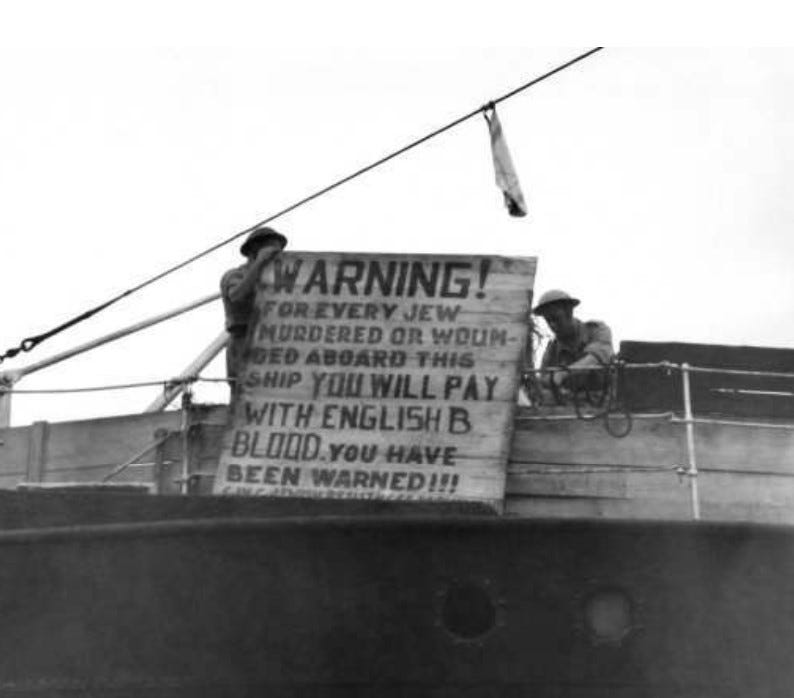
The Air Headquarters (AHQ) at Levant brought all RAF units to a state of maximum defence readiness on the 17th January 1946 in anticipation of reprisal attacks by underground terrorist organisations in Palestine. Attacks against RAF units commenced a few days later.
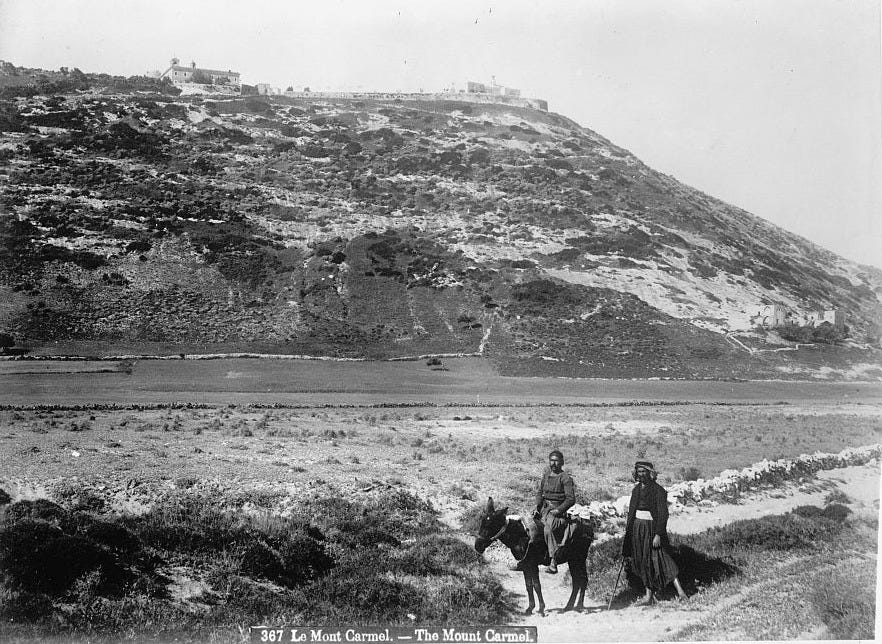
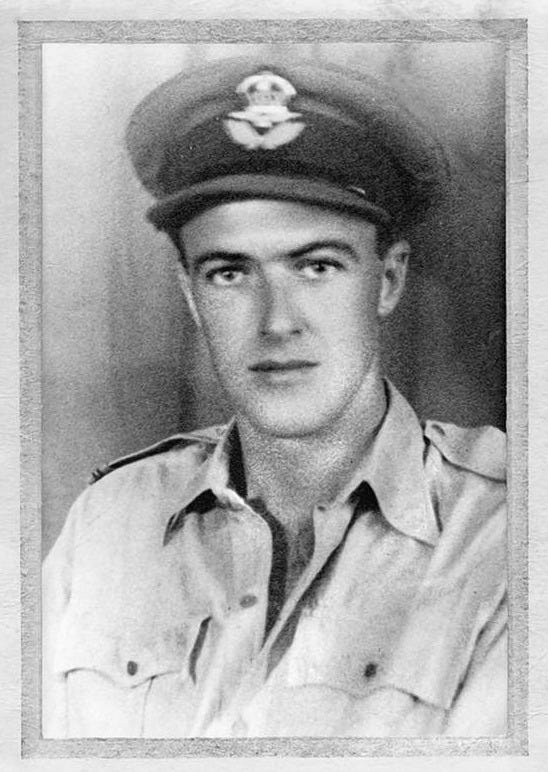
On the 21st January 1946, two haversacks packed with gelignite were found near the radar station at RAF Mount Carmel near to the airstrip at Haifa, known as Ramat David where Roald Dahl went solo in his Hurricane back in June 1941.
The radar station was used for spotting suspicious shipping vessels carrying illegal immigrants into Palestine.
A telephone warning was made at 20:18hrs on the 20th advising the occupants to evacuate the camp. The haversacks, with gelignite and fuses attached were found lodged between a blast wall and a wall of the experimental station and safely defused.
Approximately an hour after the warning was issued to RAF Mount Carmel, seventeen people, including fifteen British soldiers, a British Constable and an Arab Constable, were injured in a separate explosion on a coast guard spotting post at Givath Olga.
At the end of January, a fire broke out at the radar site and burned fiercely for about an hour and was accompanied by small explosions that destroyed two huts. The fire broke out immediately after the withdrawal of military patrols following a series of protest meetings and was believed to have been accidental.
However, a few weeks later, on the 20th February, terrorists laid explosive charges against the building at around 03:30Hrs. The explosives were detonated, seriously wounding two RAF NCOs with six other RAF Aircraftmen sustaining minor injuries. RAF personnel opened fire against the attackers as they withdrew.
The illegal Jewish defence organisation, Haganah claimed responsibility for the attack and in a broadcast from the secret “Voice of Israel” station, a Haganah spokesman said that RAF personnel had been warned in advance to evacuate the station it was thought that to indicate that an illegal immigrant ship was approaching Palestine.
As part of a series of terrorist attacks against British military installations, members of the Jewish Irgun organisation raided the RAF stations at Petah Tiqva, Qastina and Lydda on the night of 25th February 1946.
During these raids they destroyed 14 RAF aircraft, valued at £750,000, using techniques similar to the British Commando raids against Rommel’s airfields in North Africa during the Second World War.
Under heavy supporting fire, the terrorists crept up and placed explosives under the aircraft parked on the runways and dispersals. Most of the aircraft were destroyed by placing explosives in the air intakes or under the wings, whilst other aircraft were destroyed after they burst into flames after being attacked with machine guns and mortars.
The first of the attacks was at RAF Qastina, south of Jaffa, a Transport Command airfield, where eleven Halifax B.MkVII’s of No 644 Sqn were written off beyond economic repair following an attack by Irgun terrorists that commenced at 20:45Hrs. The eleven aircraft had apparently been withdrawn from service and were parked awaiting a decision on their disposal. The eleven aircraft destroyed were: NA358, NA359, NA362, NA430, NA431, NA464, PN255, PN303, PN306, PN310 and PN311.
RAF personnel were supposed to guard these eleven Halifaxes (along with other aircraft, and airfield facilities) against possible terror attacks. However, it turned out that the terrorists were undeterred, and penetrated the airfield's defences, using intelligence provided by civilian contractors working on the base.
Despite the presence of armed guards, the terrorists attacked the aircraft and started several fires. Apart from reporting the attack to the RAF Qastina Guardroom, the armed guards took no action to stop the attack.
The attack was a considerable embarrassment to both the RAF and the British Government and subsequently, some members of the RAF Police Armed Guards were later disciplined for their failure to prevent the attack.
No casualties were sustained by Squadron personnel, but one of the terrorists was killed in the action.
At RAF Petah Tiqva, also known as RAF Sirkin or Camp Sirkin, the whole airfield was encircled by a perimeter fence and adjacent to the 32 Sqn complex, on the other side of the wire was a Jewish Kibbutz. The personnel of 32 Squadron soon found out that the occupants of the kibbutz were hostile towards their presence.
At first, the aircraft were parked on their dispersal area and were patrolled by Sqn personnel who were carrying out patrols on both the aircraft and the perimeter fencing. However, due to close proximity of the aircraft to the Kibbutz, it was decided that it would be safer if the aircraft were dispersed along the main runway and patrolled by Army personnel in armoured cars.
At RAF Petah Tiqva, personnel from 32 Sqn as well as others from the unit were in the station cinema admiring the shapeliness of Betty Garble in a film being shown when the explosions occurred around 21:00hrs. The station personnel all turned out to a view of a glowing sky from the burning aircraft.
On investigation, it was discovered that seven aircraft had been sabotaged by exploding packages of gelignite in the aircraft radiator intakes. Whilst carrying out checks of the remaining aircraft, Sqn Ldr Sylvester found a further package in the radiator of another aircraft and a revolver that had been dropped by one of the attackers as well as holes cut in the barbed wire fencing near to the Kibbutz.
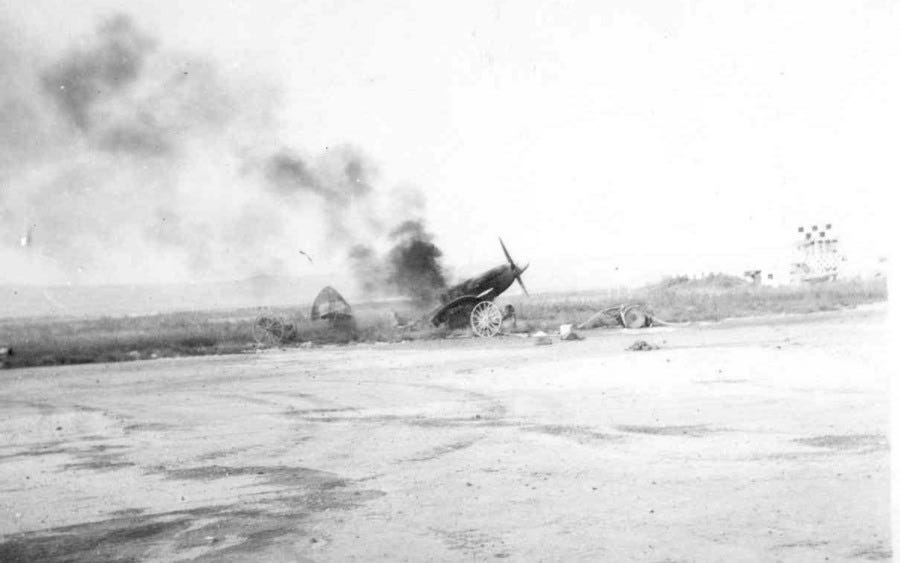
The following morning when daylight arrived, the sorry sight of wrecked aircraft became apparent.One burnt out aircraft lay drunkenly on its side with the skeleton of a wing pointing to the sky. Six more aircraft stood disconsolately with great gaps torn in their wings, surrounded by bits and pieces scattered over a large area by the explosions.
Two of the damaged Spitfires belonged to No 32 Sqn and the remaining five to No 208 Sqn.
The next day, after careful inspection of the remaining aircraft, 32 Sqn put on a show of force by flying all over the towns and settlements in the area with seven Spitfires to prove they were still operational.
An hour and half after the Petah Tiqva attack had started, all lights at RAF Lydda failed and the airfield was attacked by the terrorists throwing grenades and exchanging rifle fire with the guards, destroying two Ansen’s and two light communication aircraft.One of those aircraft destroyed was Anson Mk.XI, PH605.
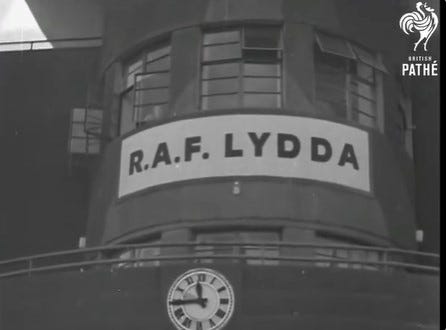
At RAF Lydda, the terrorists gained access by mingling with troops leaving the camp cinema. Lydda was one of those RAF Stations where, earlier in January over 700 RAF personnel went on strike for 3 days refusing to take orders, essentially a mutiny, over the slow demobilisation and return of troops back to the UK following the end of the Second World War.
Following the attack at Lydda, troops from the 6th Airborne Division were deployed into Lydda questioning more than 5,000 Jews in house-to-house visits, subsequently becoming known as the biggest man hunt in Palestine since the end of the war.
Airborne troops also entered the Jewish settlement at Givat Hashoshia, where the settlers were not observing the curfew, and the troops threatened to open fire on those found in the streets. After some negotiations, the settlers were allowed to move around within the confines of the settlement.
Was the idea of moving the aircraft from the dispersal to the main runway a good idea or not? If they had been left on the dispersal, would the damage have been worse? Was the lack of security down to disheartened service personnel awaiting return to the UK for demob?