Lieutenant-Colonel John Dane Player
One of the first items that I have that sparked my interest in military history is an old ‘smoked stained’ album of cigarette cards given to me by my Uncle.

The album which features Military Uniforms of the British Empire Overseas contains 50 full colour cigarette cards featuring military units and their uniforms from the following countries: South Africa, Southern Rhodesia, Australia & New Zealand, Canada, India & Burma, Nigeria, Gold Coast, King's African Rifles, K.A.R. Somaliland Camel Corps, Northern Rhodesia Regiment, Trans-Jordan Frontier Force, British Guiana Militia, British Honduras Defence Force. and Singapore Volunteer Corps.
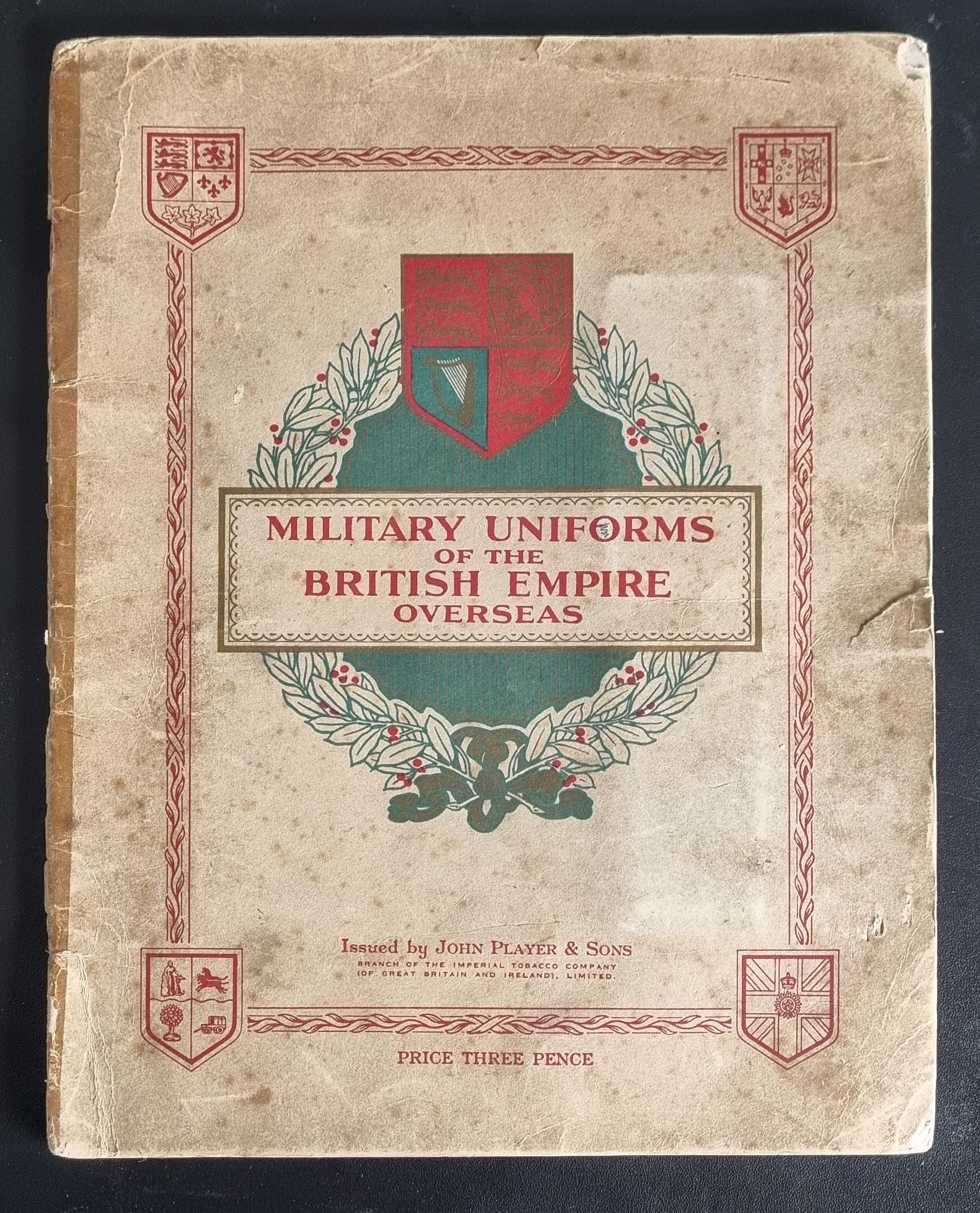
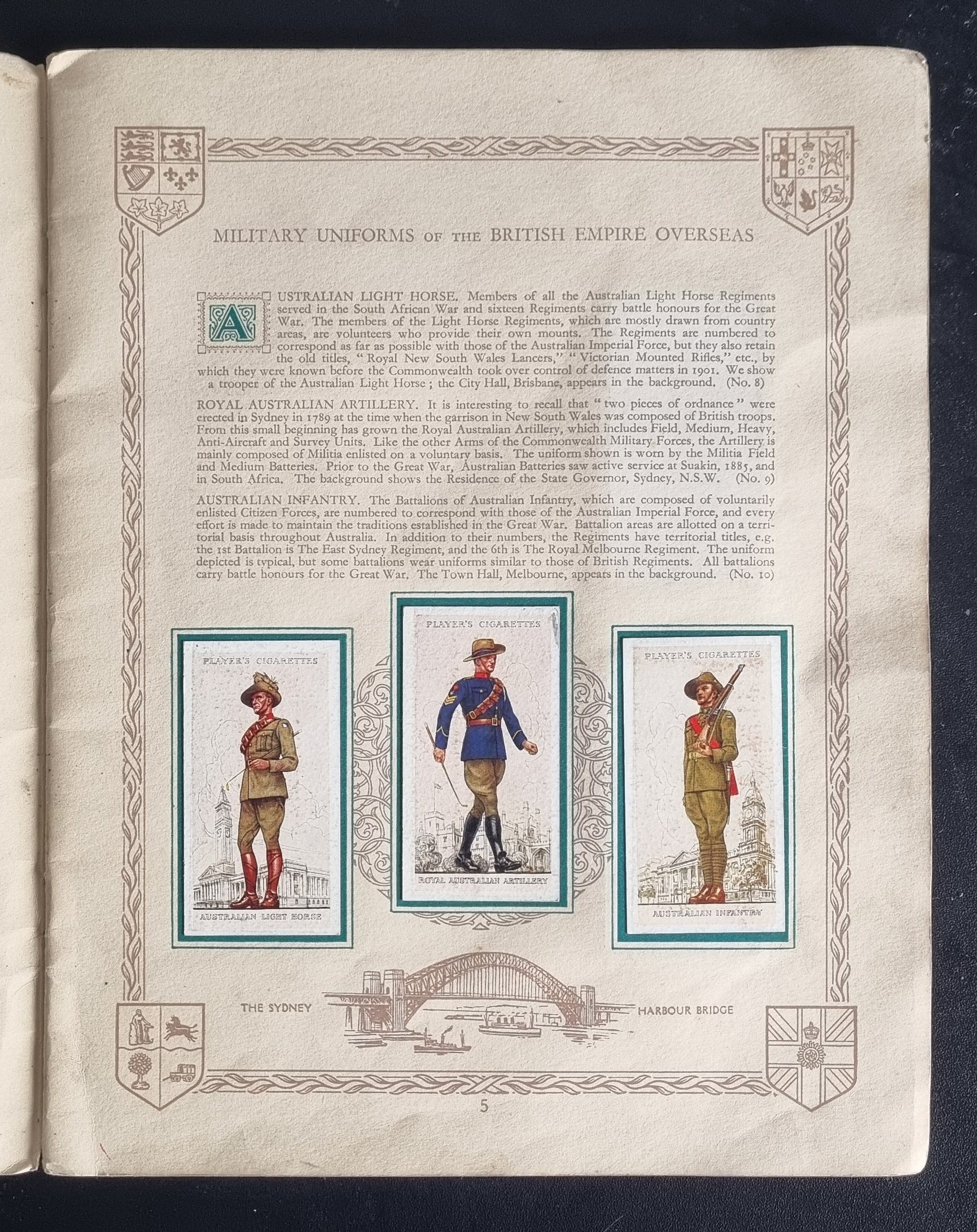
It was issued in 1938 by John Player and Sons and is not really worth a lot of money, but is a sentimental item for me as my Uncle used to tell me about the uniforms of Southern Rhodesia as this was where he served with he RAF during World War Two.
But who was John Dane Player?
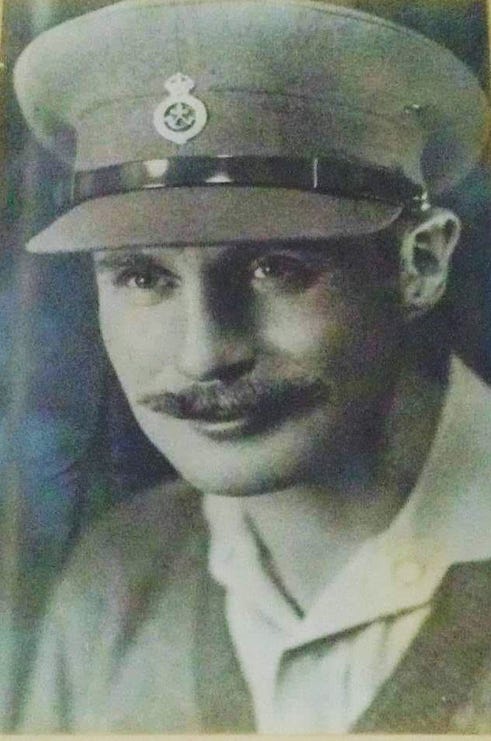
Lt.Col. John Dane Player, was born in Nottinghamshire in 1903, the grandson of the founder of the John Player and Sons cigarette company.
John Player who founded the cigarette company began his career in tobacco by purchasing a shop on Beastmarket Hill Nottingham, selling seeds and fertiliser.
After initially selling these products to farmers and agricultural workers he became interested in tobacco as a commodity, he bought loose tobacco and sold it as a side-line as ‘screws’ to farmers. However, the sale of tobacco was proving more lucrative than the sale of seeds and fertiliser.
By 1871, Player was registered as a Tobacconist, employing one man and three boys. By 1877, he was so successful with these products that he bought a small tobacco factory, previously owned by the tobacconist William Wright at number 45, Broadmarsh Nottingham.
Now as a tobacco manufacturer, Player registered the first trademark of the company; the image of Nottingham Castle. The Registered Trademark was his guarantee to the consumers that the products were of high quality. He planned to expand the business further and develop a range of products that were easily recognised by the consumer, encouraging brand loyalty. Player’s original tobacconist’s shop continued to do good trade even after Player moved on to tobacco manufacturing.
This idea for marketing his products proved successful and by 1881 there were 80 people under the employ of John Player and this figure grew as demand increased. Player purchased land in Radford so that another three factory blocks could be built. The first block of the Castle Factory (alternatively known as No. 1 Factory) was opened in 1884 on Radford Boulevard, while the other two blocks were hired by lace manufacturers until Player’s company grew enough to require the extra space.
At this time No. 1 was one of the largest factories in the world, with one room 300 feet long by 60 feet wide, the machinery was driven by a 300-horse power engine. The remaining two factory blocks were not used by Player’s until the first branded cigarette was manufactured in 1889; Player’s Gold Leaf Navy Cut. The demand for these cigarettes was so high that the workforce had to be increased to approximately 500 employees.
On 9th December 1884, John Player died; just after the completion of the Castle Factory on Radford Boulevard.For nine years a group of his close friends ran the business until his two sons, John Dane (1864 – 1949) and William Goodacre (1866 – 1959), were ready to take over in 1893.Two years later, John Player & Sons was made a private limited company and John Dane and William Goodacre became managing directors.William Goodacre Player was the father of Lieutenant Colonel John Dane Player.
John Dane Player Junior, or 'Donny' as he was known, was educated at Harrow and joined the family business with his father William and Uncle John Dane (senior). He retired in 1933 due to health reasons and then went to South Africa.
Donny returned to England a few years later and settled at Friars Rest in Wartnaby where he began farming. He was also a keen sportsman, loved the outdoor life and hunted regularly with the Quorn, Belvoir and Cottesmore hunts becoming one of the best known characters in the Leicestershire hunting circles.
Quite often he would put on dinner parties for the hunting community at his home at Friar’s Well in Wartnaby.In December 1936, he was seriously hurt in a fall at Adams Gorse between Knossington and Braunstone and was rushed to the Melton Mowbray War Memorial Hospital.In December 1937, he broke a collar bone whilst riding with the Belvoir Hunt.
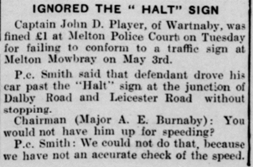
At some point in the mid-late 30’s he joined the Army in serving with he Territorials and in 1937, he appeared in the Melton Police Court charged with “Ignoring the Halt Sign”. The newspaper article published in the Melton Mowbray Times on 21st May 1937 listed him as a Captain.
Later the same year, he was granted a divorce from his wife Mrs Leila Player whom he married in 1928. Three days after their marriage was dissolved, she married Lord Manton in the Caxton Hall registry office in London.
Donny is remembered for his activities on summer camp when he took along his two Great Danes, Lion & Simba. He is also remembered for driving his Rolls Royce around camp with two tin baths tied to the rear bumper each with an Officer siting in them.
When the Second World War broke out, Donny was in command of C Squadron of the Nottinghamshire Yeomanry, Royal Armoured Corps. In September 1940, whilst serving in Palestine and Tobruk he became second-in-command of the Regiment under Lt.Col. Flash Kellett.
He fought in the North African desert and whilst operating behind enemy lines in Libya while on reconnaissance with the Long Range Desert Group he was captured and taken prisoner on Christmas Day 1942. His captor was Major Hans von Luck, the Commander of the 3rd Panzer Reconnaissance Battalion of the 21st Panzer Division.
He was reported as ‘Missing believed Prisoner of War’ on Casualty List 1049 (Officers).

After interrogation by Rommels chief of staff, Fritz Bayerlein, he was handed over to the Italians from whom he escaped by getting his Italian guard drunk!

Another story is that apparently, Donny was going to be exchanged for 600k cigarettes but when he found out he was only worth 600k he refused as he said he was worth over a million cigarettes!
With the help of local Arabs, he was able to make his way back to British lines and rejoined the Regiment on 20th January 1943 having walked over 150 miles.
Casualty List 1053 (Officers) provided an update on all casualties reported to the War Office Casualty Section for the 48 Hours ended 9am 8th February 1943.

When Col. Kellett left to be second-in-command of the 8th Armoured Brigade at the beginning of March 1943, Donny took command of the Regiment.
On the evening of 24th April 1943 while reconnoitring a route through the Tunisian town of Enfidaville his jeep came under mortar fire.The occupants of the jeep, Intelligence Officer Capt. Myles Hildyard, driver Trooper John Matkins and Col. Donny Player immediately ran to a ditch.
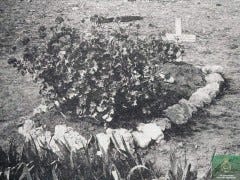
Donnys grave, taken on Easter Sunday, just after his burial at Enfidaville, Tunisia.
When the shelling stopped Donny complained about loss of feeling in his legs, although no sign of a wound could be found.
He was put back in the jeep and driven to the Regimental Aid Post where it was found that a shell splinter had entered his shoulder and travelled down through his body.
He subsequently became delirious and died during the early morning of Easter Sunday, 25th April 1943. He was forty years of age.
He now lies at rest in Enfidaville War Cemetery, Tunisia.
Following his death, he left an estate of £206,808 2s 6d he bequeathed £3,000 to the Belvoir Hunt, for the benefit of the agricultural population of the district and to encourage them to keep their hedges and gates in good repair, believing that “the hedges of this part of the country are a great asset to its beauty.”
Leaving his residence Friar’s Well for use as a residence by the incumbent of Wartnaby, the testator urges that the churchyard be kept in good condition so that it will always be recognised as one of the best kept in the countryside.
After several personal bequests and gifts to employees, he left the residue to the diocese of Leicester for the benefit of the living in the village of Wartnaby. “No individual is to be appointed who does not approve of hunting, shooting, football and other many sports which develop the best qualities of mankind”.
In St Michael’s Church at Wartnaby there is a slate tablet that reads “The restoration of this Church was made in 1948-1950 by the generosity of Lieut. Colonel J D Player of Friars Well, Wartnaby, who was Killed In Action in the Middle East in 1943”
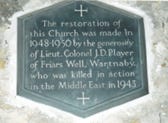
There is a similar plaque in St Leonard’s Church at Holwell that reads “The restoration of this church was made in 1948 by the generosity of Lieut. Colonel J.D.Player of Friars Well, Wartnaby, who was Killed in Action in the Middle East in 1943.”